Big Idea Vacuum Two Zones Diagram Proof Facts Video FAQ
✈️

How Do Planes Fly?

The answer is simpler than you think. Two zones. One vacuum. That's it. No maths needed.

Let's Find Out! 🚀

🤯 The Big Idea

A plane wing doesn't push air down. It sucks itself up by creating a vacuum above it. Think of it like a giant, invisible magnet pulling the plane into the sky.

💨 How the Blue Vacuum Zone is Created

This is the secret! As the wing moves forward, the slanted top surface called the Inductor pulls away from the air, leaving a gap. That gap becomes a transient void — a vacuum.
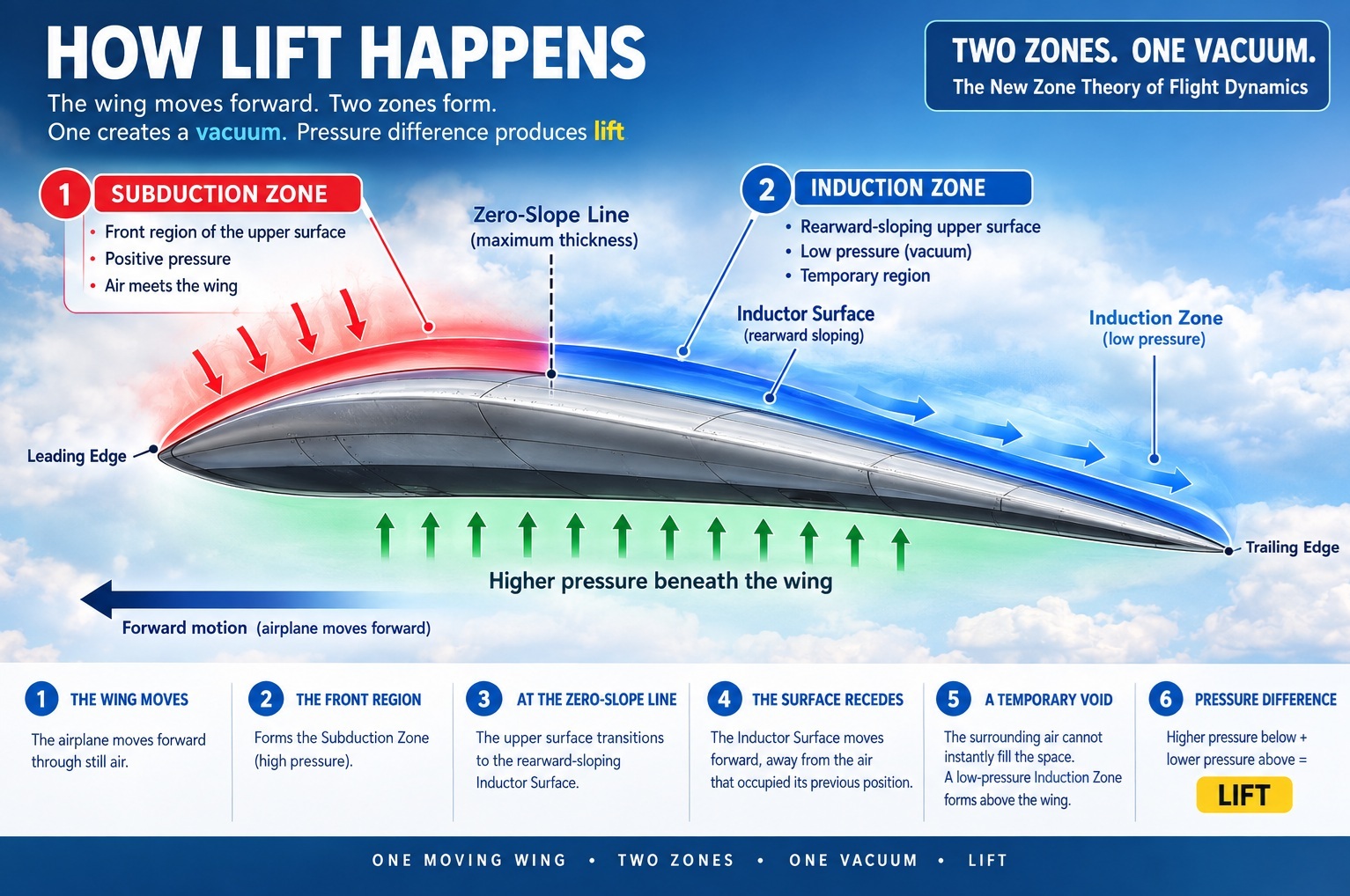
Transient void or induction zone diagram
1

Wing Moves Forward

The wing travels through the air at velocity V.

2

Air Can't Keep Up

The slanted top surface called the Inductor moves away, leaving a gap behind it.

3

Blue Vacuum Forms

That gap becomes the Transient Void (blue zone) above the wing.

4

Lift is Created

The higher pressure below pushes the wing up into the void. Lift!

🎯 The Two Zones of a Wing

Every wing has two parts that work together like a team.

ZONE 1 🟢

The Induction Zone

The main body of the wing. The slanted top surface (called the Inductor) leaves a gap in the air as the wing moves, creating a vacuum above. The bottom pushes up against that vacuum — and boom, you have lift!

ZONE 2 🔴

The Subduction Zone

The front part of the wing. It gently catches the air and guides it smoothly over the top. Think of it like a ramp that helps air climb onto the wing.

📐 See It For Yourself

Here's what the two zones look like on a real wing.
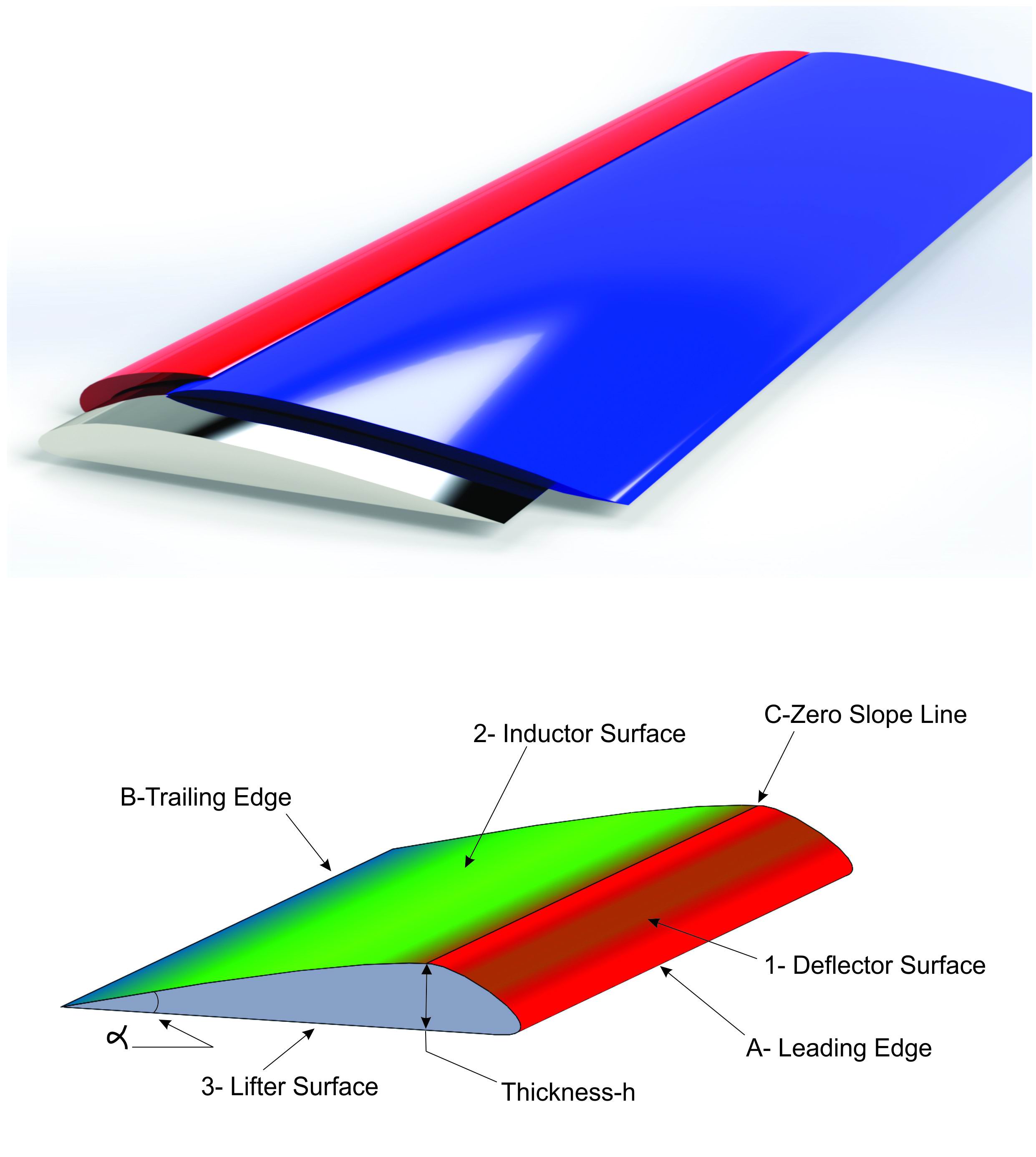
Wing diagram showing Subduction Zone (red), Inductor Surface (blue top), and Lifter Surface (green bottom)

The red front = Subduction Zone. The blue top = Inductor. The green bottom = Lifter.

🔬 Proof It's Real!

Don't just take our word for it — see the Zone Theory happening in real life.
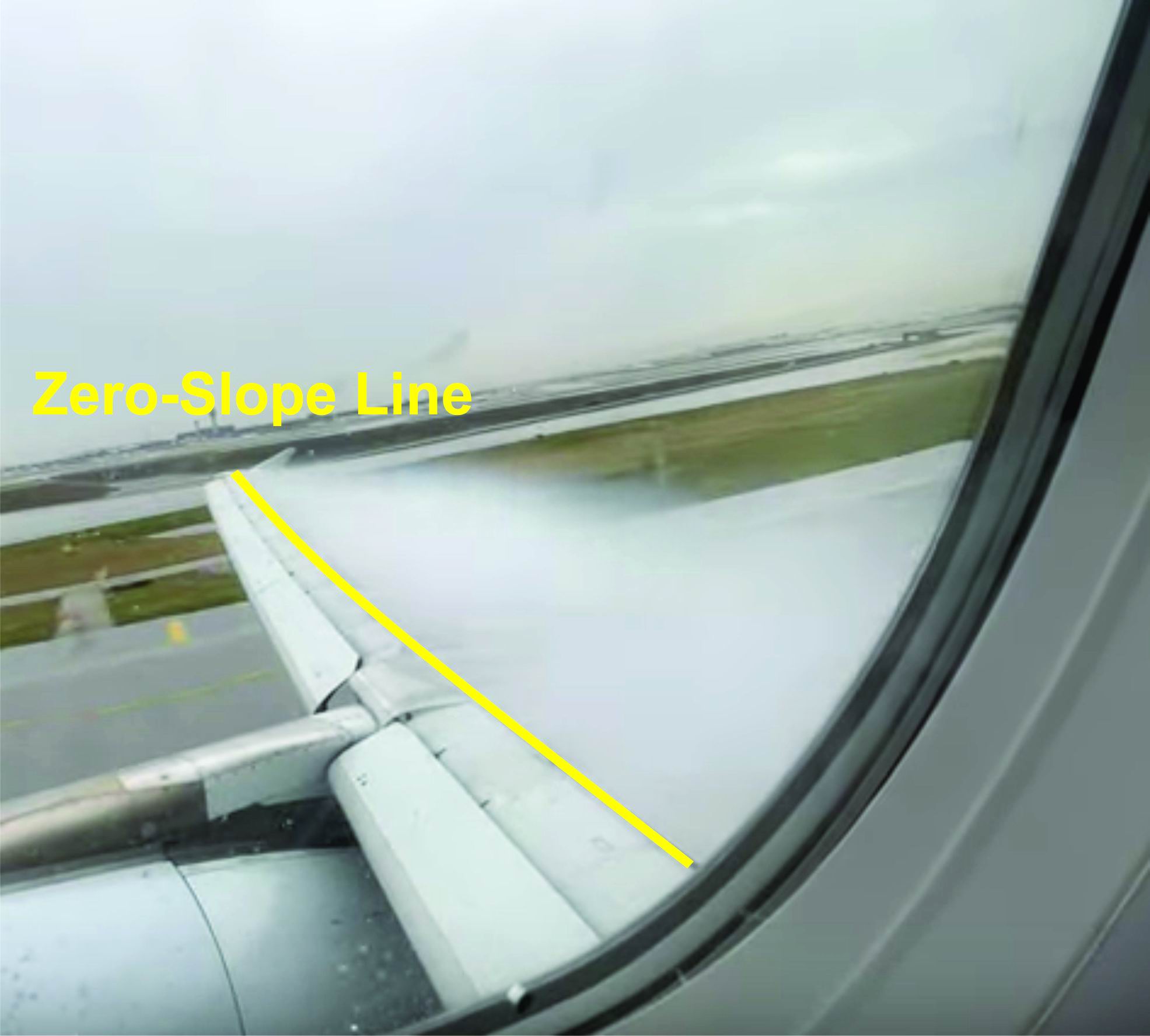
☁️ Wing Clouds on a Boeing 757

Boeing 757 wing at takeoff showing cloud formation
What you're seeing: A snapshot from a video of a Boeing 757 at takeoff. The creation of the low-pressure induction zone causes the moisture in the air to condense and form wing clouds over the wing. Condensation occurs only between the Zero-Slope Line and the trailing edge. There is no cloud formation in the high-pressure subduction zone — exactly as stated by the Zone Theory.
💡 Why this matters: If the old theories were correct, we'd see clouds everywhere on the wing. But we only see them in the Induction Zone — right where the vacuum forms. This is real, visible proof that the two zones exist and behave exactly as the theory predicts.

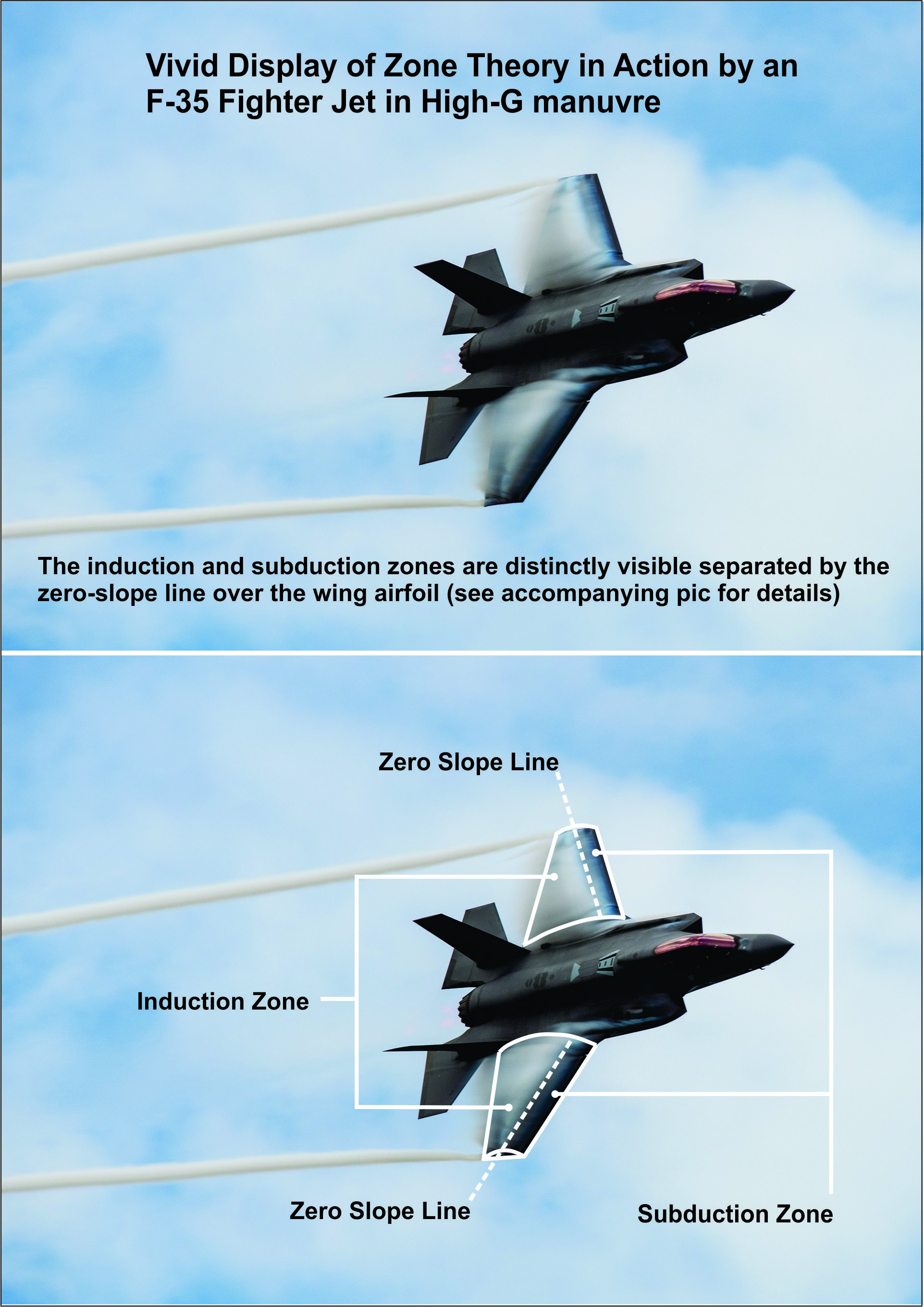
⚡ F-35 Fighter Jet in High-G Maneuver

F-35 fighter jet in high-G maneuver showing vapor cone
What you're seeing: A vivid display of the Zone Theory in action by an F-35 fighter jet during a high-G maneuver. The Induction Zone and Subduction Zone are distinctly visible, separated by the Zero-Slope Line over the wing airfoil.
💡 Why this matters: Even at extreme speeds and G-forces, the two zones remain clearly separated. You can literally see the boundary between them — the Zero-Slope Line — dividing the high-pressure Subduction Zone from the low-pressure Induction Zone.

🎉 Fun Facts

Things that will make you say "whoa."

🚀

No Angle of Attack Needed

The Zone Theory says lift happens because of the wing's shape — not because it's tilted into the wind.

✈️

Jumbo Jets Weigh 400 Tons

And they fly because of the same two zones. The vacuum above the wing is strong enough to lift a small building.

🌍

Birds Use the Same Trick

Birds create the same induction zone with their wings. Nature figured out the Zone Theory millions of years before we did!

🎥 Watch It In Action

See the two zones during a real first flight.

Click to Play: The Two-Zone Theory

❓ Questions Everyone Asks

So… planes don't push air down? +
Not in this theory! The New Zone Theory says lift comes from a vacuum created above the wing. The wing literally gets sucked upward.
What's the Subduction Zone? +
It's the red front part of the wing. It gently guides air into the Induction Zone so the vacuum can form smoothly.
Why all previous explanations have failed? +
Previous explanations tried to use complex maths and confusing ideas like "air travels faster over the top" or "air is pushed down." None of them could explain the transient void (the vacuum) that forms above the wing. The Zone Theory looks at what's actually happening: the wing leaves a gap in the air, and that gap creates lift. No maths needed — just two zones and one vacuum.
Why planes and birds have to run in order to leave ground? +
Because the vacuum needs movement to form! A stationary wing leaves no gap in the air. Planes need to accelerate down the runway, and birds need to run or flap to build up speed. Once they're moving fast enough, the Induction Zone creates a strong enough vacuum to lift them off the ground. No speed = no vacuum = no lift.
What is airfoil action? +
Airfoil action is the entire process of the wing moving through the air to create lift. It has two steps: (1) the Subduction Zone guides the air smoothly over the wing, and (2) the Induction Zone leaves a gap that becomes a vacuum, pulling the wing upward. Together, this is "airfoil action" — the wing's shape turning forward motion into lift.